Methodology
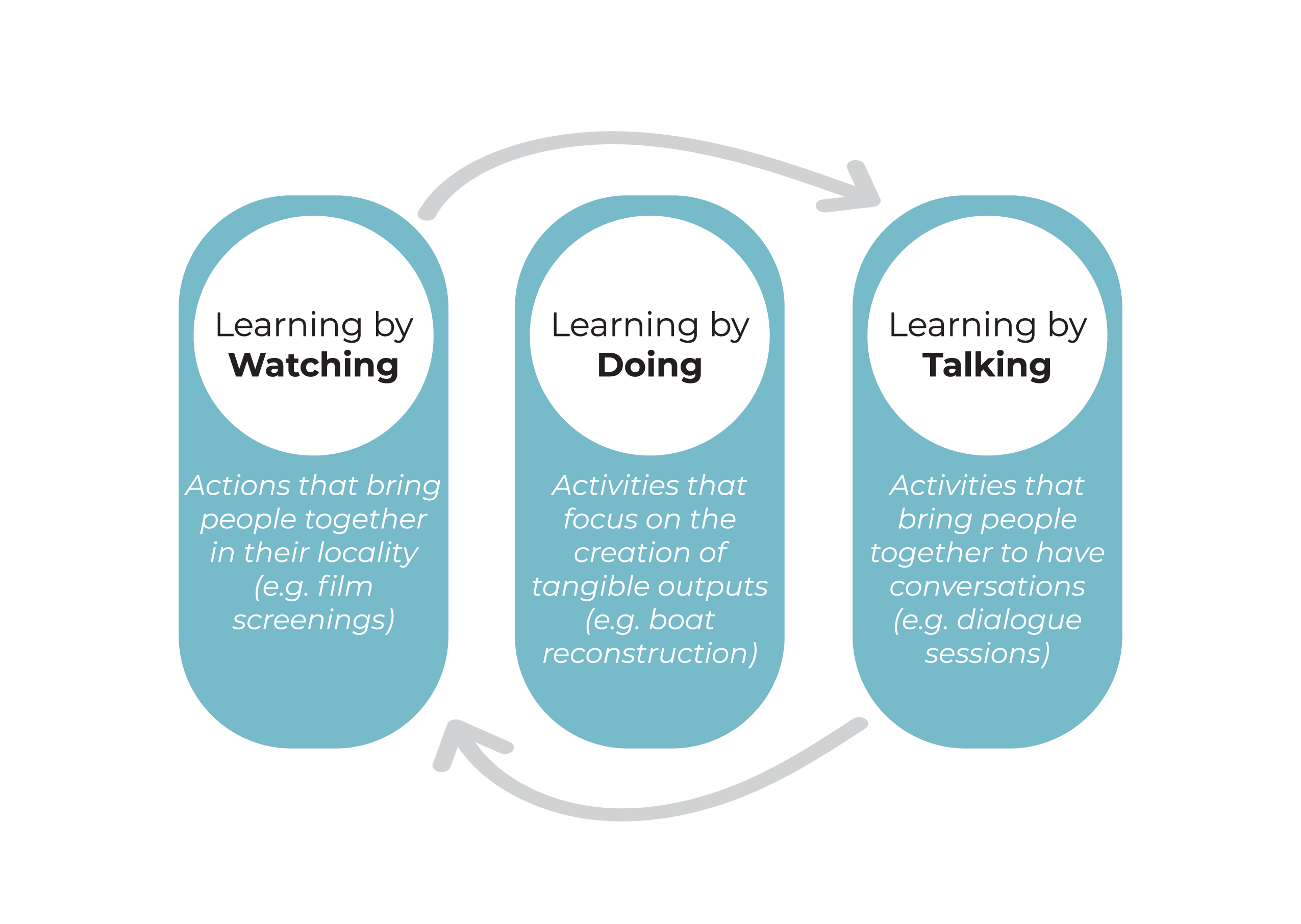
The Place, People, and Art-based Model functions as a conceptual and programmatic model for GOODLand based on orevious art projects by Martha Atienza carried out on Bantayan Island (Gilubong akon Pusod sa Dagat in 2011) and (Para sa Aton in 2014). This is a three-tier model that contains three dimensions, namely, Learning by Watching, Learning by Doing, and Learning by Talking. As a non-liner model, all three dimensions oocur simultaneously. This means that a given project e.g., boat reconstruction, contains all three methodological components and dimentions in circular manner.
The Methodological Framework
Art is about action & creation, expression, and questioning fostered by a given project. Art has the capacity to engage individuals in three key ways. Firstly, action & creation implies activity in the form of artmaking. Whether we are filming or rebuilding a sailboat, we collaboratively work on the creation of materials and components of an art project and/or participate in actions related to it. Secondly, art as expression implies a process that is based on the cognitive aspect of artmaking. This makes space to focus on remembering, sharing, and gaining knowledge. In other words, people involved in a project can share their experiences, knowledge, and stories whether explicitly or implicitly. Lastly, through this process, art makes space for people to ask questions—questions that are [inter]personal and/or questions that ask questions about society and the world. Artmaking creates a sense of community by engaging in this problem-solving act.
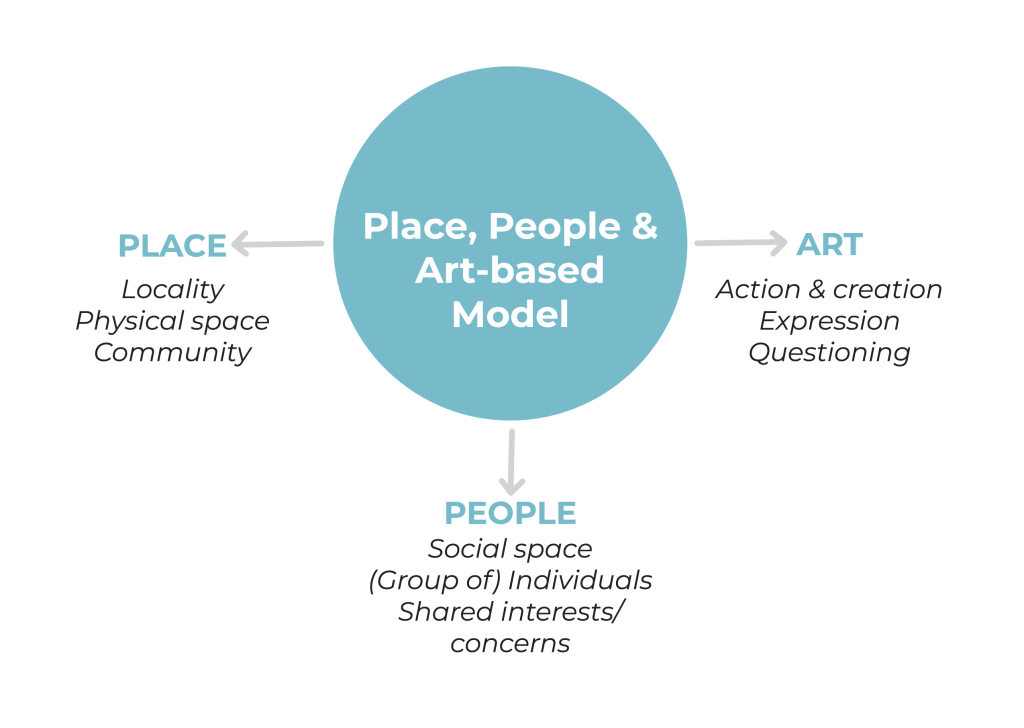
Place refers to location, physical space, and community or communities of a given locality. Firstly, locality refers to the historical, political, and contemporary context of a place. Secondly, the physical environment refers to the natural environment with geographic and natural characteristics. Lastly, the community is a conceptual or social category characterized by social relations, local dynamics, norms and values, or other group traits. An example is the Bantayan Island’s community of fisherfolk, which consists of all fisherfolk of Bantayan Island.
People can be considered as making social spaces, [groups of] individuals with shared interests, concerns, and experiences. In reference to the above-described community, here we specifically discuss people with whom we work and are in relation with, who are part of the communities. In other words, we work with specific residents, e.g. living on Mambacayao Dako, rather than the abstract social.
The Model in Practice
This three-fold methodology is non-linear, which means that a single action, e.g. boat reconstruction, encompasses a circulation of doing, watching, and talking.
Archiving is foundational as a process of community-led investigation and accumulation of a range of documentary material we continuously work in our projects and programs. Considered a living archive, it aims to reflect and give voice to the complex reality of Bantayan Island’s social, economic, and environmental issues. This material includes: field notes, audio and video documentation, and recordings of performances, conversations, and dialogues. The collection of materials makes visible marginalized knowledge and intergenerational stories and histories of our islands.